
There’s a Cher song “If I could turn back time” and as she laments a love gone wrong, the same concept has been used in Episode 3 of Season 1 of the 2019 Twilight Zone reboot to criticise and confront racist police murders of innocent black people that continue to terrorise to this day.
Nina is driving her son Dorian to college. She has with her an old VHS style camcorder that she is using to capture the road trip and these moments with her son. They stop at a diner for lunch, and as they are sitting there, a white police officer walks in and orders lunch as well, observing Nina and Dorian with the plausible deniability that covert racism of today usually has. Nina is still recording Dorian as he accidentally squirts tomator sauce on his person, so he requests she rewinds the tape, and as she does, she finds the camcorder rewinds time too.

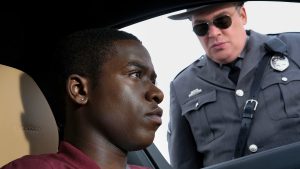
Nina and Dorian get back on the road, and as they do so, the white cop pulls them over. Nina advises Dorian to be respectful, a conversation known all too well in the black community, and yet the police officer decides to confront Nina and Dorian rudely and suspiciously, confirming Nina’s worst fears.
The cop notices she is filming and demands she stop, and so she presses rewind, and now Nina and Dorian are are back in time to earlier in the drive. Nina is dazed, still not quite sure what is going on, and so Dorian pulls the car over to check on her, only to have the cop arrive and stop behind them, sirens blazing. Dorian, worried for his mother, requests the cop call an ambulance but instead the cop reacts viciously, and pulls out his taser ready to attack Dorian. Nina hits rewind on the camcorder and they are teleported back in time, back to the safety of the diner.
Now, Nina understands what is going on, and this time after seeing the policeman at the diner already, she gets Dorian to leave mid-lunch, and they take a different route and stop overnight at a hotel. Unfortunately, the time-travelling cat and mouse game continues, with the cop arriving at the hotel having followed them, and knocks at their door, unreasonably demanding that Nina and Dorian present him their ID. As Dorian balks at the unfairness of the request, the cop tasers him.
There is no question now as to the policeman’s motives, and there is no question that Nina and Dorian are unsafe in his presence. The only question that remains is, can Nina use the camcorder to save her son’s life?

Nina presses rewind after Dorian is attacked by the policeman in the hotel room. Realising that simply fleeing the cop won’t work, this time, back in the diner, Nina tries a different tactic. She walks over the cop and buys him a piece of pie, attempting to humanise herself to him by talking about where she grew up, and empathising with him by asking about his family. The cop however has no will to change, his racism is confirmed by him making statements like “I know everyone like you” and questioning Nina on how she got her nice car. His racist stereotypes are cemented in his mind and it appears Nina’s talk to him has been in vain.
Outside, Nina and Dorian are preparing to leave when the cop approaches them, demanding proof of ownership of the car. Frustrated, Nina lashes out and insists the car is hers. The cop sees her camcorder and demands she stop recording, and she yells at the cop as Dorian pulls out his phone to find proof of ownership of the car. The cop shoots Dorian dead.
A distraught and devastated Nina arrives at the hospital to ID her son’s body and wastes no time in asking for her camcorder back. She gets it and presses rewind, bringing herself back to the diner, and back with her living son. Thrilled, Nina hurries to leave the diner with Dorian only to exit just as the cop enters.
While on the road, Nina tells Dorian about the situation they are in with the policeman, and how the camcorder has saved him so far.
Dorian suggests this time they go back to where Nina grew up, her old neighbourhood, and Nina confesses that her old neighbourhood is a source of trauma for her. They arrive at the house of Neil, one of Nina’s brothers, and she tells him what is going on.
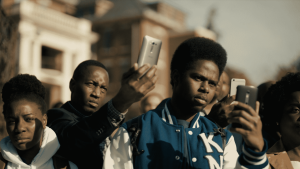
Neil helps them to use an underground path to get to the University Dorian is attending – surely a nod to the Underground railroad, the secret routes and safe houses used by enslaved African American’s as a pathway to freedom during 1810 – 1850. They make it to the schools front gates only to find the racist cop is waiting there for them, with his gun drawn. Neil and Nina stand in front of Dorian, as several more cop cars arrive. Nina holds up the camera and films. Several nearby students join her, and the cop laughs at them.
Nina stands up to the cop, telling him her son will be going to this college. Finally. The cop walks away. Its an interesting ending, one that suggests to me its a matter of community standing together, taking a stand and not backing down. Fleeing didn’t work. Fawning didn’t work. Freezing didn’t work. The only option left was to fight. I also think the fact that Dorian is on his way to college is symbolic of the fact education is a tool in fighting systemic oppression. But ultimately, it was his own self interest to not be filmed that ultimately made the police officer back down, and walk away.
Ten years later, Nina is with Dorian and his young daughter Trinity. She is still filming him with that same time-travelling camcorder. Dorian’s daughter Trinity is playing with it, and breaks it. Nina is devastated, and Dorian tells her to let it go. She agrees. And as the scene fades to black, police sirens are heard in the distance and blue and red flashing lights shine over Nina’s face.
It is in this ominous sequence of events that we as viewers are left to ponder Dorian’s fate. We aren’t presented with any facts for sure, we just know that if the police did decide to murder Dorian, there is no saving him this time. And it is inside of that torturous fact we are left to contemplate his fate. I love this ending, becuase it reinforces that it is out of their control. It is only inside the control of the bad actors, the racists, whether or not racism ends. Whether or not another black person is murdered to satisfy the prejudice of another. Nina can’t save her son because Nina wasn’t the one endangering him. It is in this lack of control that the true terror of prejudice resides, and it is on all of us to educate, agitate, and organise to end racism.
The writer of this incredible episode Selwyn Seyfu Hinds writes;
“Right now I could hang up my phone and walk outside in the streets of Los Angeles and find myself in that situation,” says Hinds, himself a person of color. “This is urgent. This is something as a nation we ignore, this horror, and in our own little way I wanted to take a sledgehammer to it.”
This episode was aired in 2019, a year before the righteous freedom movement of Black Lives Matters.
Police murdering black people in the United States continues. Please check out the links below.